When the Trial Becomes the Treasure: A Conversation with Brett Butler
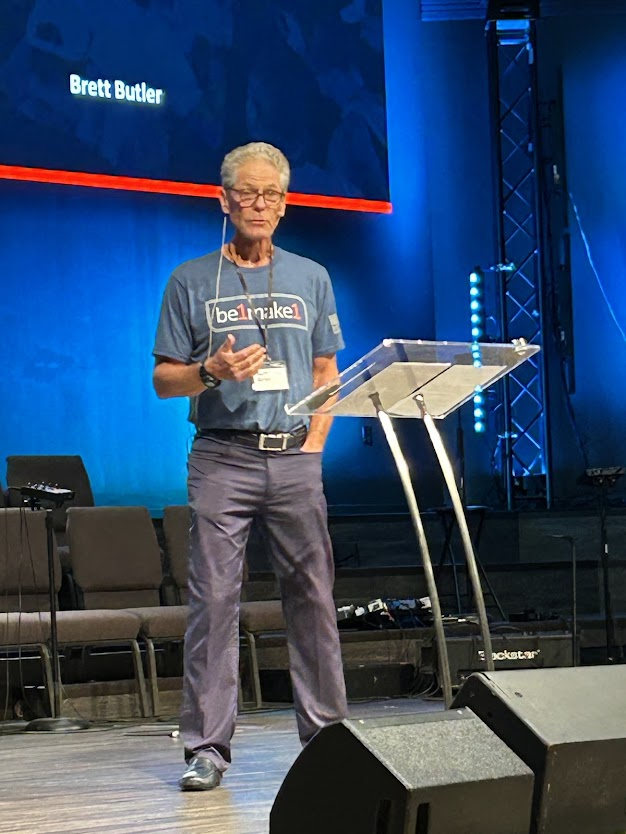 Today I had the unexpected privilege of meeting former Major League Baseball All-Star Brett Butler. I knew something of his baseball career before meeting him—the seventeen seasons in the Major Leagues, the 1991 All-Star appearance, the more than 2,300 career hits, and the remarkabl
e comeback from throat cancer near the end of his playing days. But the part of our conversation I will remember most had very little to do with baseball.
It had to do with suffering.
I had recently learned that during his battle with cancer, Brett spent time reading the book of Job. Since I am preparing to preach a message from Job entitled “A Wind from the Wilderness,” I knew that if I had an opportunity to speak with him, there was one question I wanted to ask.
“Mr. Butler, when you were going through cancer, you talked about reading the book of Job. Looking back thirty years later, what did God teach you through Job and that season of suffering that you understand more clearly now than you did then?”
He began by taking me back to 1996.
At the time of his diagnosis, there was tremendous uncertainty surrounding his baseball career. He had already played sixteen seasons in the Major Leagues and had been an All-Star in 1991, but in his mind his career was not finished. He still believed there was baseball left in him.
With a smile of self-awareness, he admitted that he “selfishly” wanted to reach 3,000 career hits before retiring.
Then cancer interrupted everything.
What began with a routine tonsillectomy revealed throat cancer. Suddenly the questions were no longer about batting averages, stolen bases, contracts, or how many seasons remained. There were doctors now. Nurses. Specialists. Surgery. Recovery. There were questions with consequences far greater than anything that had ever happened between the foul lines.
But as Brett described that season to me, somethi
ng became apparent. While cancer had interrupted his plans, it had not interrupted the providence of God.
He spoke of the remarkable number of people who became involved in his treatment—the doctors, nurses, specialists, and others whose paths crossed his because of his illness. And with those encounters came opportunities to speak about his faith and to witness for Jesus Christ.
People he might never have met otherwise were suddenly standing beside his hospital bed.
Cancer had brought them there.
What appeared to be an interruption had become an opportunity.
On May 21, 1996, Brett underwent surgery to remove cancerous lymph nodes and muscle tissue. Many doubted whether he would ever play Major League Baseball again. But Butler was determined to return.
And 108 days later, on September 6, 1996, he did.
There he was again, batting leadoff for the Los Angeles Dodgers.
It was a remarkable comeback. The kind of story sportswriters love to tell. The athlete battles cancer, defies expectations, and returns triumphantly to the field.
But as Brett continued talking, the story became quieter.
And deeper.
He returned for another season in 1997, but he told
me that period was extraordinarily difficult—not only for him physically, but especially for his family. He did not go into great detail, and I did not press him. Some chapters of our lives are too personal to be reduced to anecdotes.
Eventually, it became clear that the time had come to walk away from baseball.
And that was when he really answered my question.
Looking back across the thirty years that have passed since those days, Brett told me that he now realizes those days of difficulty were the greatest period of spiritual growth in his life—more than any time before or since.
The moment he said it, a verse came immediately to my mind.
Earlier in our conversation I had told him that I am an evangelist and that this Sunday I am preaching a message called “A Wind from the Wilderness.” The title comes from that terrible moment in the life of Job when calamity seemed to rush into his world from nowhere.
One messenger after another arrived. Loss followed loss. Then came the words:
“And, behold, there came a great wind from the wilderness…”
There are seasons like that. A doctor’s phone call. A di
agnosis. A death. A betrayal. A financial collapse. A door that suddenly closes. A life that was moving predictably in one direction is struck by a wind from somewhere we never saw coming.
And when that wind blows, it can leave us asking questions for which heaven seems to offer no immediate answers. Why this? Why now? Why my family? Why, Lord?
That is much of the struggle of Job. He does not understand what God is doing. He cannot see behind the curtain. He does not know about the conversation in heaven recorded for us in the opening chapters of the book.
But there is a moment when Job says something extraordinary:
“But he knoweth the way that I take: when he hath tried me, I shall come forth as gold.” — Job 23:10
So I said to Brett, “That is what you are describing.”
The suffering was real. The uncertainty was real. The physical pain was real. The cost to his family was real. But so was the refining work of God. The fire had not destroyed him. God had used it to refine him.
When I quoted Job 23:10, Brett looked at me and said simply: “Yes. That is exactly it.”
I have thought about those words ever since. We spend so much of our lives asking God to remove the difficult seasons. We pray for the wind to stop, the diagnosis to disappear, the door to reopen, the burden to lift, the pain to pass. And there is nothing wrong with asking God for deliverance. Job himself longed for answers.
But sometimes God does something in the wilderness that He could never have done for us in the sunshine. There are lessons about God that prosperity cannot teach us. There is a depth of prayer that ease cannot produce. There is a surrender that often comes only when our plans have been taken out of our hands. There is a knowledge of God that can be learned only when everything else we were leaning upon has been shaken.
Thirty years later, Brett Butler did not point me primarily toward the comeback. He pointed me toward the growth. That may have been the most powerful thing he could have said. Because the greatest miracle of that season may not have been that Brett Butler returned to a Major League baseball field 108 days after cancer surgery. Perhaps the greater miracle was what God was doing in the heart of Brett Butler while everyone else was watching the ballplayer. The world saw an athlete making a comeback. God was refining a servant.
And perhaps that is what He is doing in some of us right now. We see only the wilderness. We hear only the wind. We feel only the loss. But God knows the way that we take. He knows where the road is leading when we cannot see beyond the next step. He knows what He is removing. He knows what He is producing. He knows precisely how hot the furnace must become—and He knows when the refining work is complete.
One day, perhaps years from now, we may look back upon the season we would have done anything to escape and realize that it was there, in the place we would never have chosen, that we came to know God in a way we never had before.
Today I had the privilege of meeting a legendary baseball player. But I walked away more grateful that I had met a humble and gracious servant of Jesus Christ. A man who could look back across three decades, beyond the statistics, the stadiums, the applause, the cancer, the comeback, and the closing of a remarkable career, and recognize that some of the hardest days of his life had also been some of the holiest.
“But he knoweth the way that I take: when he hath tried me, I shall come forth as gold.”
Sometimes the wind from the wilderness carries away things we desperately wanted to keep. But in the hands of a sovereign God, even the wilderness can become a furnace where faith is refined into gold.